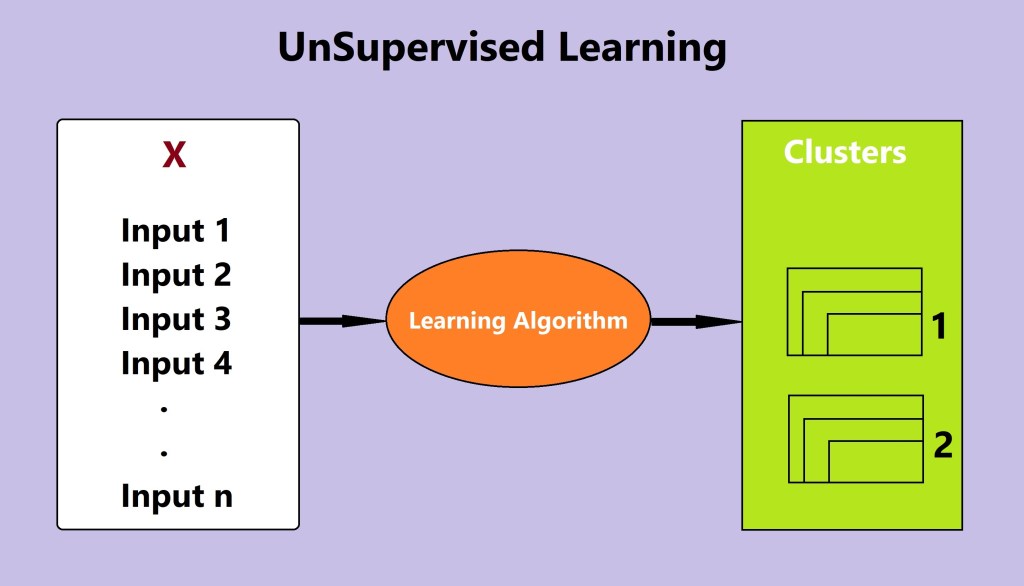
The basic idea of Unsupervised Learning is to feed machine with as much data as possible without providing any label on the data and letting machine group similar data together to form clusters and provide insights on them.
In Unsupervised Learning, the learning algorithm tries to understand relationships between various inputs without any pre-existing information.
In other words, there are only inputs present and the learning algorithm groups them into clusters.
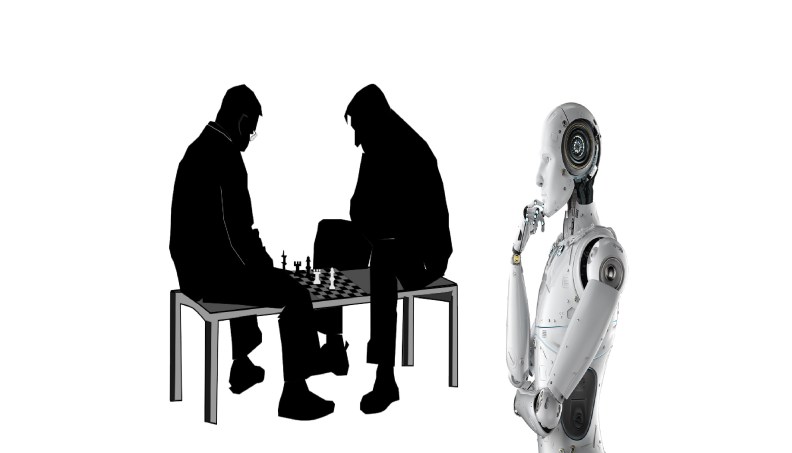
Let’s take an example. Suppose you are visiting a religious site of a religion other than yours. I am sure, it will be difficult for you to understand and perform different rituals being performed, what do you do in that case?
First you start to notice people around you:
- Are they folding their hands, if yes then how?
- Are they moving in certain direction?
- Are they chanting something?
- What kind of clothes they wore?
- Are they offering something to the idol?
- And many other questions.
At certain point you will have a basic understanding of what to do after watching people around you, you may still not know what those rituals mean but you will be able to perform those rituals.
The same thing happens with the machine, the machine takes the data, groups similar data together without knowing what they mean, and we use these groups to get insights.
Unsupervised learning has many practical applications such as:
- To group Customers based on their purchase history.
- To group patients together based on their conditions.
- To group different types of viruses to find cure for them.
One of the biggest benefits of Unsupervised learning is that you can get patterns or insights which you didn’t expect at all and could never have gotten from Supervised learning.
Question: What happens when we use Supervised learning and Unsupervised learning together?
Answer: We get Semi- Supervised Learning.
Semi- Supervised Learning is a combination on Supervised Learning and Unsupervised Learning. It means the Machine get a large amount of unlabeled data along with a small amount of labelled data. This learning helps us in getting insights on known indicators as well as on unknown ones, if any.
That’s it for now, Happy learning.
Ready to elevate your skills? Click here for my Python book and here for my Machine Learning book on Kindle.
 Ization
Leave a comment