In today’s data-driven world, many business scenarios demand insights not in hours or days, but in seconds. From monitoring IoT devices to tracking live transactions, real-time analytics enables organizations to act immediately. Microsoft Fabric delivers this capability through KQL databases and event streams, making it easier to ingest, query, and analyze fast-moving data at scale.
Introduction to KQL Databases and Event Streams
- KQL Databases (Kusto Query Language): Purpose-built for analyzing large volumes of time-series and log data with low latency. They excel in scenarios like telemetry, clickstreams, or system monitoring. Queries can summarize, join, and visualize data in near real time.
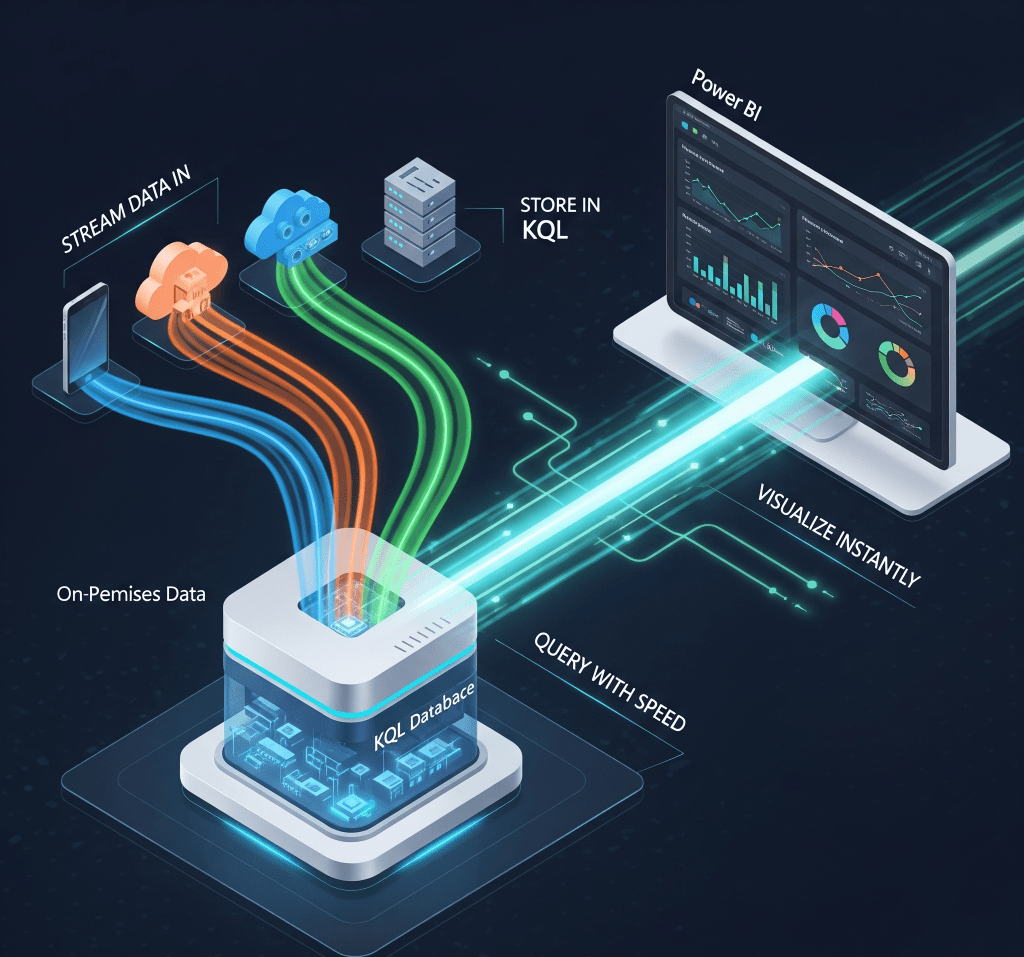
- Event Streams: Provide the pipeline for real-time ingestion. Event Streams capture data from sources such as IoT hubs, Kafka, Event Hubs, or APIs, and push it into Fabric destinations like KQL databases, Lakehouses, or Power BI dashboards.

Together, they form the backbone of Fabric’s real-time analytics capability: stream data in → store in KQL → query with speed → visualize instantly.
Setting Up Streaming Ingestion
Getting started with streaming ingestion in Fabric typically involves three steps:
- Connect a data source: Choose a live data source such as Azure Event Hubs, IoT Hub, or Kafka.
- Define an event stream: In Fabric, configure an Event Stream item to capture incoming data. You can enrich or filter the stream before it lands.
- Route the data: Direct the event stream into a KQL database for querying, or into a Lakehouse for longer-term storage.
Once data is ingested, you can run KQL queries for real-time analysis or plug the results straight into Power BI for live dashboards.
Real-World Use Cases
Fabric’s real-time analytics unlocks powerful scenarios across industries:
- IoT Monitoring: Track sensor readings from devices in manufacturing, logistics, or healthcare. Trigger alerts when values exceed thresholds.
- Live Dashboards: Provide up-to-the-second visibility into business KPIs like website traffic, sales transactions, or operational performance.
- Alerts & Notifications: Combine KQL queries with event processing rules to automatically send alerts (e.g., detecting fraud attempts, server downtime, or network anomalies).
These scenarios highlight how real-time insights allow organizations to move from reactive to proactive decision-making.
Key Takeaway Microsoft Fabric makes real-time analytics approachable by combining Event Streams for ingestion and KQL databases for lightning-fast querying. Whether you’re monitoring IoT devices, enabling live dashboards, or setting up automated alerts, Fabric provides an end-to-end solution for streaming data at scale.
 Ization
Leave a comment