While working with Microsoft Fabric, a question came to mind: why use a Data Warehouse if the Lakehouse already provides a SQL endpoint? At first glance, it may seem redundant. However, when you look closer, the two serve very different purposes, and understanding these differences is key to knowing when to use each.
Lakehouse vs. Data Warehouse in Fabric
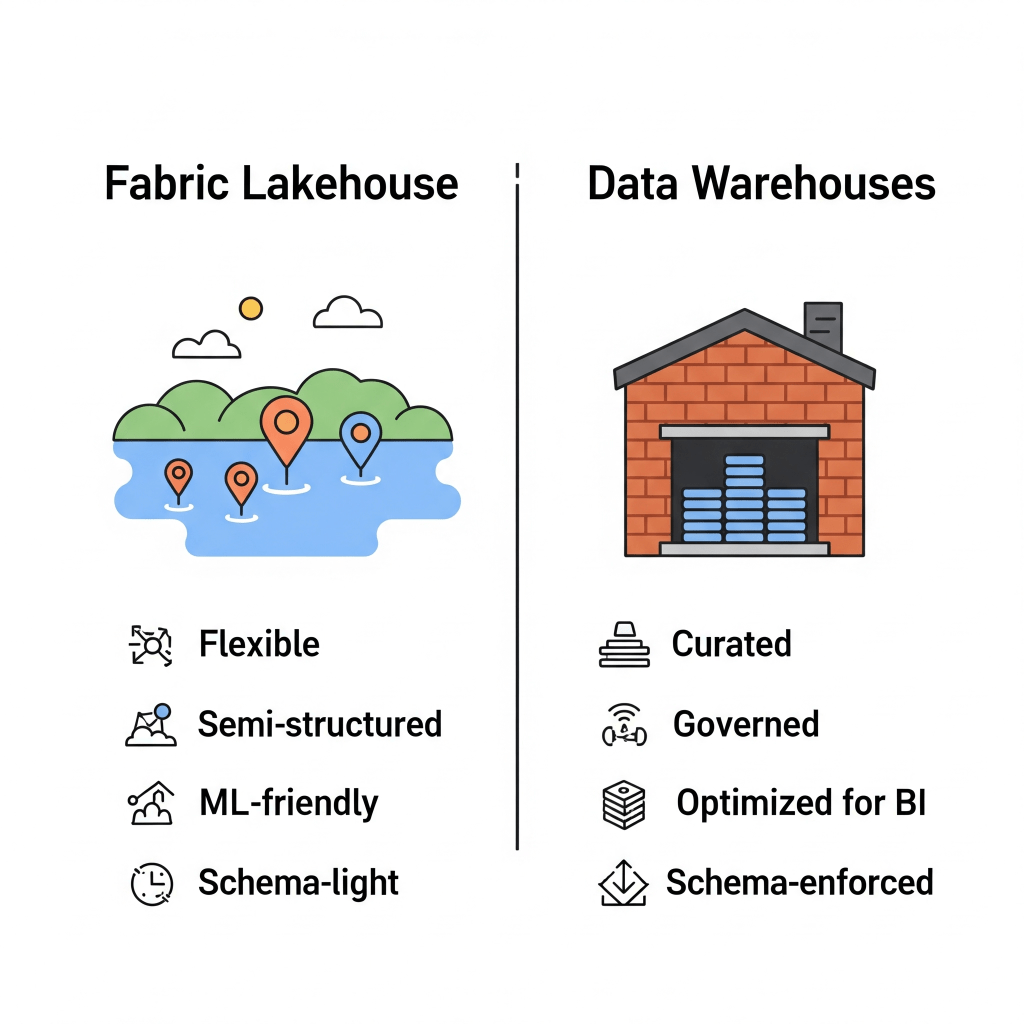
Lakehouse
- Stores structured and semi-structured data (Parquet, Delta, CSV, JSON, etc.).
- Designed for data engineering, data science, and machine learning use cases.
- Supports raw → staging → transformed zones in one place.
- Offers a SQL endpoint, but it’s not fully optimized for high-concurrency, low-latency BI queries.
- Flexible with schema changes and great for exploratory workloads.
Data Warehouse
- Purely relational storage, accessed with T-SQL.
- Optimized for analytics query performance and concurrency.
- Best suited for business-ready, curated data marts.
- Seamlessly integrates with Power BI, Excel, and third-party BI tools.
- Enforces stricter schemas and governance, reducing risk of “data chaos.”
Do You Really Need a Data Warehouse?
You probably do, if:
- You need high-performance SQL queries at scale.
- You support many business analysts who prefer SQL or Excel.
- You want clean, curated data marts with enforced governance.
You might not, if:
- Your team mainly does data science and ML from the Lakehouse.
- Most reporting can be satisfied with direct Power BI connection to Lakehouse tables.
- You’re fine with a bit more flexibility in schema management.
The Common Pattern
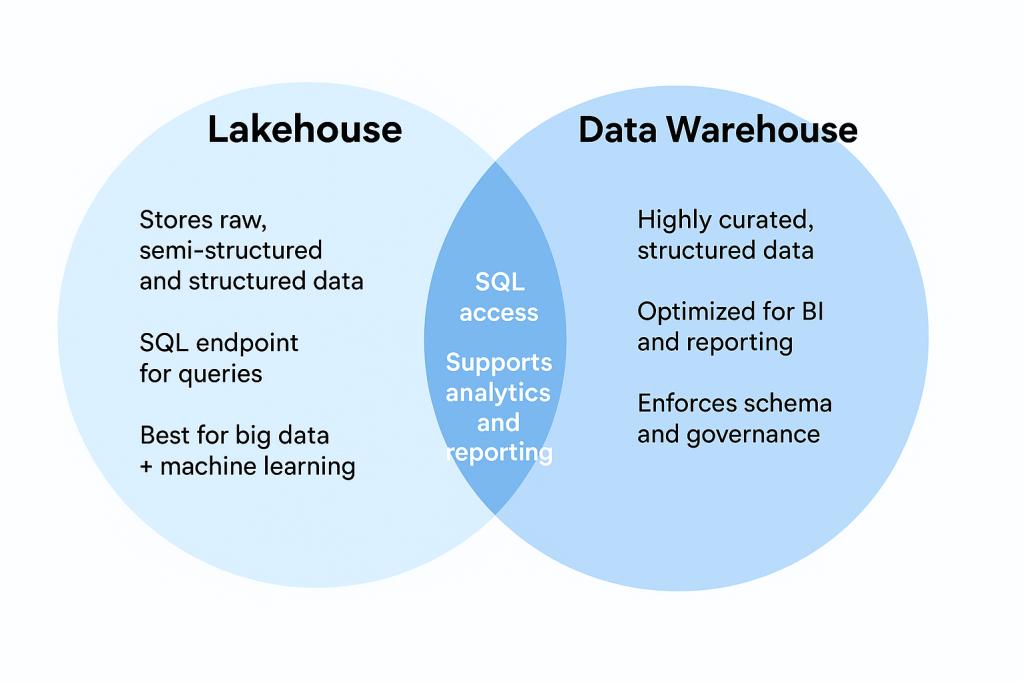
Most organizations end up using both:
- Lakehouse for raw data ingestion, staging, and transformation.
- Warehouse for curated, high-performance, business-ready marts.
- Power BI (or Excel/SQL) primarily consumes from the Warehouse, while engineers and scientists work in the Lakehouse.
Final Thoughts

The question isn’t really Lakehouse vs. Warehouse, but rather how they complement each other. Fabric gives you both so you don’t have to choose, you can stage and experiment in the Lakehouse, then promote curated, governed data into the Warehouse for enterprise-grade analytics.
So, while you don’t need a Data Warehouse in every Fabric project, in most enterprise BI scenarios it becomes the natural place to serve trusted, performant, and governed data.
 Ization
Leave a comment