
Artificial Intelligence (AI) is everywhere these days, from personalized Netflix recommendations to chatbots that answer your questions in real-time. But not all AI is built the same. A key distinction exists between traditional AI approaches and the rising star: Generative AI (Gen AI).
So, how exactly is Generative AI different from other AI systems? Let’s break it down in simple terms.
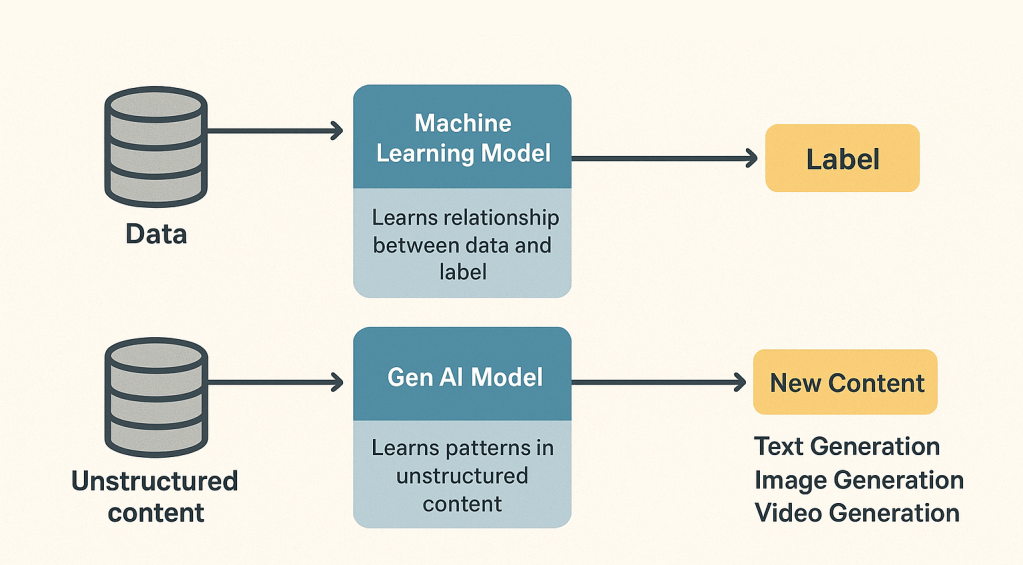
Traditional AI: Learning Relationships
Think of traditional AI like a very smart student who studies data and learns to give you the right answer.
- Inputs: Data + Labels
- Process: The AI model learns the relationship between the input data and the label.
- Output: A prediction or classification.
For example:
- Feed it thousands of labeled pictures of cats and dogs, and it will tell you whether the new picture is a cat or a dog.
- Use it on sales data, and it might predict future revenue.
Common applications include:
- Classification (Is this email spam or not?)
- Regression (What will the house price be next year?)
- Recommendation systems (What movie should you watch next?)
In short, traditional AI is like a tool that takes what it has learned and applies it to recognize, predict, or recommend.
Generative AI: Creating Something New
Generative AI takes things a step further. Instead of just labeling or predicting, it creates brand-new content.
- Input: Data (often unstructured, like text, images, or video).
- Process: The AI learns patterns in that data.
- Output: Entirely new content that resembles the data it was trained on.
For example:
- It can generate a brand-new article from scratch.
- It can create realistic images of places that don’t exist.
- It can even produce video clips or music.
Applications of Generative AI include:
- Text generation (chatbots, copywriting tools, code assistants).
- Image generation (AI art, product mockups).
- Video generation (short clips, synthetic avatars).
Think of it like this: If traditional AI is the student who answers test questions correctly, Generative AI is the student who goes home, writes a novel, paints a picture, or composes a song inspired by everything they’ve learned.
Why Does This Matter?

The difference matters because Generative AI expands what AI can do. It’s not limited to answering questions or categorizing data, it can produce new ideas, designs, and possibilities. This makes it a powerful tool for creativity, automation, and innovation.
- Businesses use it to speed up content creation.
- Designers use it for brainstorming visuals.
- Developers use it to generate code snippets.
- Everyday users interact with it as conversational AI.
Generative AI is transforming industries, pushing the boundaries of what’s possible with technology.
Wrapping Up
To summarize:
- Traditional AI = Recognizes patterns, labels data, makes predictions.
- Generative AI = Creates brand-new content inspired by patterns in data.
Both are powerful, but Generative AI is opening the door to a future where humans and machines co-create.
Final Thought: Traditional AI tells you what is. Generative AI imagines what could be.
 Ization
Leave a comment