Artificial Intelligence (AI) is no longer just a buzzword. It is a powerful technology that is reshaping how we work, communicate, and make decisions. Over the years, AI has evolved from simple rule-based systems into advanced machine learning models that can interpret data, learn patterns, and generate human-like responses.
Today, the real magic of AI lies in its capabilities. These are the practical functions that bring intelligence into software applications. Let’s explore the key AI capabilities that developers are using to build smarter, more responsive, and human-like systems.
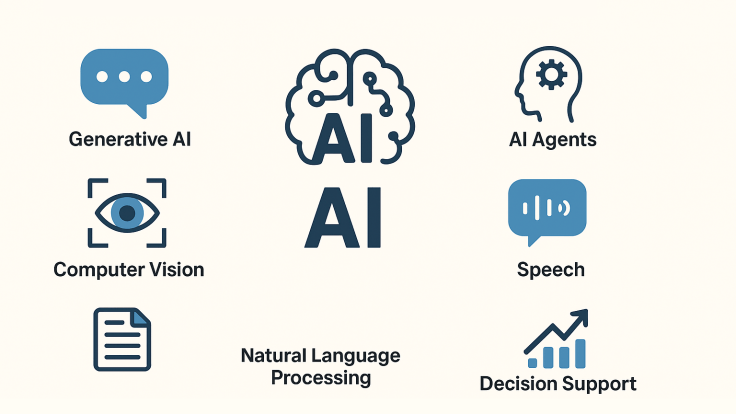
1. Generative AI: Creating New Content
Generative AI enables applications to create original responses, ideas, and content. Instead of simply retrieving information, these models generate new outputs based on patterns in data.
Example: A real estate platform can automatically generate property descriptions and advertising copy for listings, saving hours of manual effort while keeping the tone professional and appealing.
2. AI Agents: Taking Action Autonomously
Agents go beyond responding to prompts. They can assess situations and act on behalf of the user, bringing automation and problem solving into real-world tasks.
Example: An AI-powered executive assistant could remind you of a meeting, provide directions, suggest transportation options, and even book your ride.
3. Computer Vision: Understanding the Visual World
Computer vision allows machines to see and interpret images, videos, and live camera feeds. It is one of the most practical and widely used applications of AI.
Example: Automated grocery store checkouts can instantly recognize items in a basket without needing barcode scans.
4. Speech: Recognizing and Generating Voice
Speech technology enables applications to understand spoken input and generate spoken responses. It makes interacting with machines as natural as talking to another person.
Example: Digital assistants let you ask questions or give instructions out loud, then respond with lifelike spoken answers.
5. Natural Language Processing (NLP): Making Sense of Language
NLP helps applications analyze and understand both written and spoken language. From extracting meaning to identifying tone, NLP turns unstructured language into actionable insights.
Example: A marketing tool could analyze social media mentions of a company, translate posts into a target language, and categorize them as positive or negative based on sentiment.
6. Information Extraction: Pulling Key Details from Content
Information extraction combines computer vision, speech, and NLP to identify and capture important details from documents, forms, images, and recordings.
Example: Automated expense claim systems can read scanned receipts, extract line-item details, dates, and totals, and enter them into financial systems.
7. Decision Support: Powering Smarter Choices
AI can learn from historical data to identify trends, correlations, and patterns. These insights are then used to make predictions that guide better decisions.
Example: Real estate firms can analyze demographic and economic data to forecast property market trends and set competitive prices.
Why These Capabilities Matter
Each of these AI capabilities transforms raw data into intelligent actions. Whether it is automating tedious tasks, enhancing customer experiences, or creating new business opportunities, AI is redefining what software can achieve.
The key for developers and businesses is to identify which capabilities align with their goals. Once this is clear, they can select the right AI services and integrate them into their applications. The result is smarter, faster, and more human-like solutions.
Final Thought: AI is not just one technology. It is a collection of powerful capabilities, and the more we understand each of them, the better we can unlock AI’s potential to solve real-world challenges.
 Ization
Leave a comment